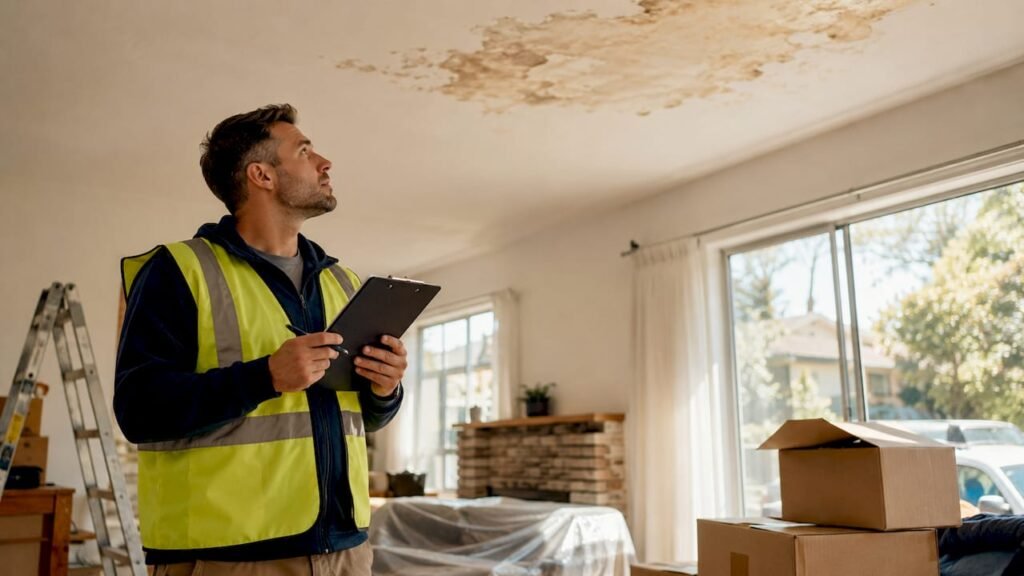
Restoration is the process of returning a damaged home to its pre-loss condition, and it plays a direct role in protecting and increasing resale value by addressing the structural and functional defects that buyers and inspectors flag first. Unlike renovation, which upgrades or modernizes a home, restoration repairs what is broken. Sellers who confuse the two often overspend on granite countertops while ignoring a water-damaged subfloor or a mold problem in the basement. The 2026 Cost vs. Value data and Opendoor research confirm that exterior restoration projects consistently outperform interior remodels in return on investment, making strategic restoration the smarter financial move before listing.
How does restoration affect home resale value compared to renovation?
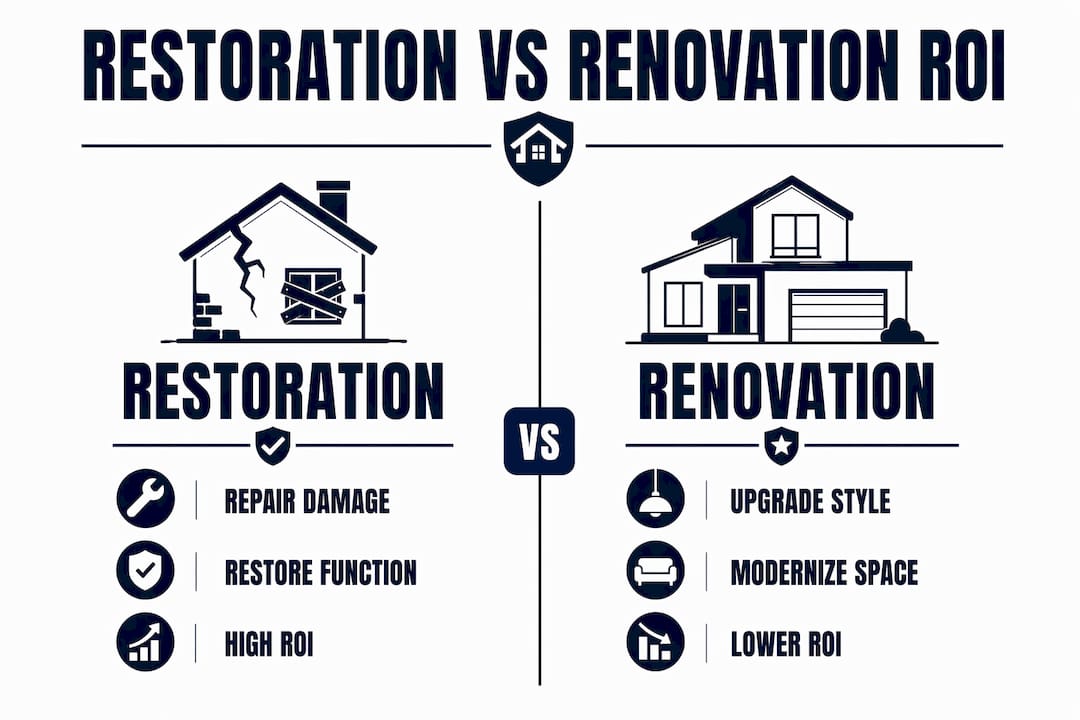
Restoration and renovation are not interchangeable, and treating them as such is one of the most expensive mistakes a seller can make. Restoration repairs existing materials after fire, water, or mold damage to return a home to its pre-loss state. Renovation replaces or upgrades materials to modernize a space. For resale purposes, restoration addresses the issues that directly affect a buyer’s willingness to close.
Buyers pay for condition, function, and curb appeal. A home with a repaired roof, dry basement, and mold-free walls signals to buyers that the property has been maintained. A home with a luxury kitchen remodel but visible water stains on the ceiling sends the opposite message. Buyers and their agents are trained to look past cosmetic upgrades and focus on structural soundness.

The financial data supports this clearly. Upscale kitchen remodels recoup only 38% to 52% of their costs at resale. That means a $60,000 kitchen overhaul might add $23,000 to $31,000 in value. Compare that to a garage door replacement, which averages 268% ROI, or a steel entry door replacement at 216% ROI. Restoration projects that address real damage return far more per dollar spent than interior remodels that reflect personal taste.
| Category | Restoration | Renovation |
|---|---|---|
| Primary goal | Repair damage, restore function | Upgrade or modernize |
| Buyer impact | Removes deal-breakers | May or may not match buyer taste |
| Typical ROI | High (exterior: 200%+) | Variable (interior: often under 60%) |
| Inspection outcome | Reduces flagged issues | Rarely affects inspection findings |
Pro Tip: Get a pre-listing inspection before deciding between restoration and renovation. Inspectors identify the exact defects buyers will negotiate against, so you spend money where it actually protects your sale price.
Which restoration projects deliver the highest ROI before selling?
The 2026 remodeling data is unambiguous: exterior projects dominate the return on investment rankings, and most of them are restorative rather than cosmetic. Garage door replacements average 268% ROI at a cost of roughly $4,672, generating approximately $12,526 in added value. Steel entry door replacements average 216% ROI at around $2,435 in cost. These numbers reflect a simple economic reality: exterior replacements require less demolition and labor, which means a higher share of your investment converts directly into added resale value.
Roof repairs follow a similar pattern. Roof repairs typically recoup 100% of their costs at resale, and they remove one of the most common deal-killing inspection findings. A buyer who sees a flagged roof in an inspection report will either walk away or demand a price reduction that far exceeds the repair cost. Fixing the roof before listing eliminates that leverage entirely.
Interior restoration projects also matter, but the priority order is clear. Water damage remediation, mold removal, and foundation repairs belong in Tier 1 because they affect structural integrity and health. Minor kitchen refreshes, such as repainting cabinets or replacing hardware, belong in Tier 2 because they improve presentation without the cost of a full remodel. Full bathroom or kitchen overhauls belong in Tier 3 and should only be considered if the market specifically demands them.
Here is a practical framework for prioritizing repairs before listing:
- Tier 1 (must fix): Water damage, mold, roof leaks, foundation issues, electrical hazards, plumbing failures. These are inspection red flags that kill deals.
- Tier 2 (selective): Exterior paint, entry door, garage door, landscaping, minor fixture updates. These improve curb appeal and first impressions with strong ROI.
- Tier 3 (optional): Full kitchen or bathroom remodels, flooring upgrades, interior painting beyond touch-ups. These carry personal taste risk and lower ROI.
Pro Tip: Focus your budget on Tier 1 and Tier 2 repairs before spending anything on Tier 3. A buyer who falls in love with your curb appeal will still walk if the inspection reveals a flooded basement or active mold.
How restoration builds buyer confidence and speeds up your sale
Buyers form their perception in seconds based on exterior condition. A restored exterior signals that the interior has been maintained with the same care. That first impression directly influences whether a buyer schedules a showing, makes an offer, and at what price.
Beyond curb appeal, restoration reduces the friction that slows or kills sales. Homes with unresolved water damage, visible mold, or deferred structural repairs generate inspection reports full of objections. Each objection becomes a negotiating point, and buyers routinely request price reductions of two to three times the actual repair cost. A seller who spends $3,000 on professional mold remediation before listing avoids a $9,000 price reduction demand after inspection.
The psychological dimension matters too. Research on buyer behavior confirms that functional, sound homes outperform stylistically upgraded ones in buyer preference. Buyers are not designers. They want to know the home will not surprise them with a repair bill in the first year of ownership. A restored home communicates exactly that.
Restored homes also close faster. Fewer inspection findings mean fewer contingencies, fewer renegotiations, and less time between accepted offer and closing. In competitive markets like Lake County and Cook County, IL, a clean inspection report is a genuine competitive advantage that keeps your deal on track.
When to invest in restoration before selling, and when to sell as-is
The decision to restore before selling depends on three factors: your budget, your timeline, and your local market conditions. Not every seller should invest in restoration. Selling as-is makes sense when renovation costs or timelines exceed your resources, when the market is hot enough that buyers will compete regardless of condition, or when your buyer pool is primarily investors who expect to do their own work.
That said, most sellers in standard market conditions leave money on the table by skipping restoration. Here is a step-by-step decision framework:
- Order a pre-listing inspection. A pre-listing inspection costs $300 to $500 and identifies every issue a buyer’s inspector will find. This gives you the information to make a rational repair decision rather than guessing.
- Categorize every finding. Sort inspection findings into Tier 1, Tier 2, and Tier 3 using the framework above. Tier 1 items are non-negotiable if you want to sell at market value.
- Calculate the cost vs. price reduction risk. For each Tier 1 item, estimate the repair cost and compare it to the likely buyer price reduction demand. In most cases, fixing the issue costs less than the negotiated reduction.
- Assess your timeline. Water damage restoration and mold remediation can be completed in days to weeks by a certified contractor. Major renovations take months. If you need to list quickly, restoration is the faster path.
- Evaluate your market. In a seller’s market with low inventory, buyers accept more risk. In a balanced or buyer’s market, condition becomes a stronger differentiator and restoration pays off more reliably.
- Get professional estimates before deciding. Understanding your restoration cost estimate upfront prevents surprises and helps you set a realistic listing price.
The most successful resale strategies focus on restoring essential systems and enhancing curb appeal rather than chasing costly interior remodels. That principle holds across most markets and most price points.
Key takeaways
Restoration protects resale value by eliminating deal-breaking defects, while exterior repairs deliver the highest ROI and buyer confidence of any pre-sale investment.
| Point | Details |
|---|---|
| Restoration vs. renovation | Restoration repairs damage; renovation upgrades style. For resale, restoration delivers higher and more reliable ROI. |
| Exterior projects lead ROI | Garage door and entry door replacements return 200%+ on investment, far outperforming interior remodels. |
| Tier 1 repairs protect price | Water damage, mold, and roof issues must be fixed before listing to prevent inspection-driven price reductions. |
| Pre-listing inspection pays off | A $300 to $500 inspection identifies every issue buyers will negotiate against, enabling smarter repair decisions. |
| Sell as-is has a place | In hot markets or with investor buyers, selling without restoration can be the right financial choice. |
What I’ve learned about restoration and resale after years in the field
Most homeowners I talk to have the same instinct: spend money on the kitchen or the master bath because “that’s what buyers want.” The data says otherwise, and so does experience. I have seen sellers invest $40,000 in a kitchen remodel only to watch a buyer’s inspector flag a water-stained basement ceiling and demand a $15,000 price reduction. The kitchen did not save them. The unaddressed water damage cost them.
The homes that sell fastest and closest to asking price are not the most renovated. They are the most maintained. Buyers are not looking for a showroom. They are looking for a home that will not ambush them with a repair bill. Restoration delivers that assurance in a way that new tile and stainless appliances simply cannot.
I also see homeowners skip the pre-listing inspection because they are afraid of what they will find. That fear is understandable, but it is the wrong call. Finding a mold problem before listing gives you time to fix it on your terms, with a contractor you choose, at a price you negotiate. Finding it during a buyer’s inspection gives the buyer all the leverage.
The practical advice is straightforward: fix what is broken before you try to make it beautiful. Address water damage and mold first. Restore your exterior. Then, and only then, consider cosmetic updates if your budget and timeline allow. That sequence protects your sale price and your timeline better than any remodel.
— John
How Masterservicepro can help you restore and sell with confidence
If you are preparing to sell and you know, or suspect, that water damage or mold is lurking in your home, Masterservicepro is the team to call. Their IICRC-certified technicians handle water damage restoration and mold remediation under one roof, which means no juggling multiple contractors and no gaps in the restoration process. That A-to-Z service model is exactly what sellers need when time and budget are tight.
Masterservicepro serves homeowners across Lake County, Cook County, DuPage County, Will County, and Kane County, IL. Whether you are dealing with a flooded basement, hidden mold, or post-water-damage repairs, their team responds fast and backs every job with a 100% satisfaction guarantee. Explore their remodeling and maintenance services to see the full range of pre-sale restoration work they can handle for you.
FAQ
Does restoration increase home value before selling?
Yes. Restoration removes structural and functional defects that buyers and inspectors flag, which prevents price reductions and keeps your sale on track. Exterior restoration projects like garage door and entry door replacements return over 200% on investment according to 2026 Cost vs. Value data.
What is the difference between restoration and renovation for resale?
Restoration repairs existing damage to return a home to its pre-loss condition. Renovation upgrades or modernizes a space. For resale, restoration addresses the issues buyers care most about: structural integrity, water damage, mold, and functional systems.
Should I fix water damage before listing my home?
Yes. Unresolved water damage is one of the most common inspection findings that triggers buyer price reduction demands. Professional water damage repair before listing typically costs far less than the negotiated reduction a buyer will request after their inspector finds it.
When does selling as-is make more sense than restoring?
Selling as-is makes sense when restoration costs exceed your budget, your timeline is too short for repairs, or you are in a hot seller’s market where buyers compete regardless of condition. Investor buyers also typically purchase as-is and price their offers accordingly.
How much does a pre-listing inspection cost?
A pre-listing inspection typically costs between $300 and $500. It identifies every issue a buyer’s inspector will find, giving you the information to prioritize repairs and set a realistic asking price before you go to market.