TL;DR:
- Mold remediation quality assurance involves independent inspection and testing to confirm complete mold removal. It includes visual checks, moisture mapping, air and surface sampling, and laboratory analysis to produce a legally defensible clearance report. Confirming proper procedures ensures long-term safety and protects property value during real estate and insurance transactions.
Mold remediation quality assurance is the independent verification process that confirms mold has been safely and completely removed from your property. Known in the industry as post-remediation verification, or PRV, it combines visual inspection, moisture measurement, air and surface sampling, and laboratory analysis to produce a legally defensible clearance report. The ANSI/IICRC S520 standard governs this process and sets the pass/fail criteria that certified inspectors follow. Without this verification step, you have no documented proof that the remediation worked, which puts your health, your property value, and any insurance or real estate transaction at risk.
What are the key steps in mold remediation quality assurance?
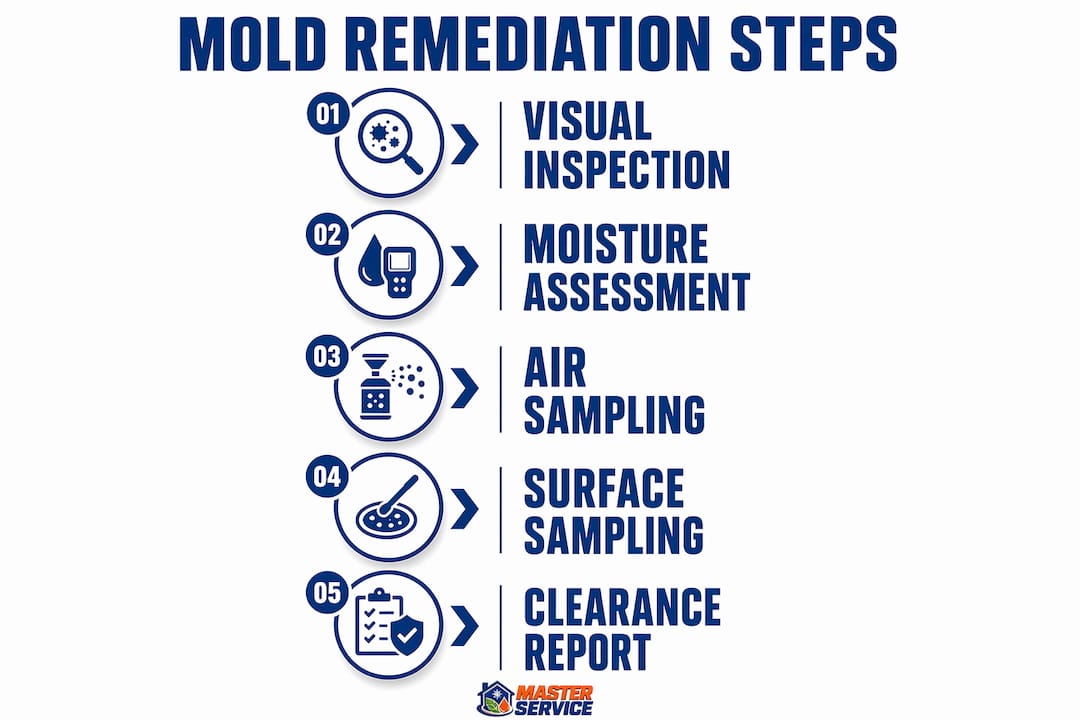
Post-remediation verification follows a defined sequence. Skipping any step produces unreliable results, so understanding each phase helps you hold your contractor and inspector accountable.
Step 1: Visual inspection
The inspector examines every surface inside the remediated area for visible mold residue, settled dust, and debris. A “white glove” standard applies: surfaces must be visibly clean before any sampling begins. Fogging or encapsulation without physical removal can hide mold from a visual check, which is why this step requires a trained eye, not just a quick walkthrough. Containment barriers must also be intact, with no tears, gaps, or breached seals.
Step 2: Moisture assessment
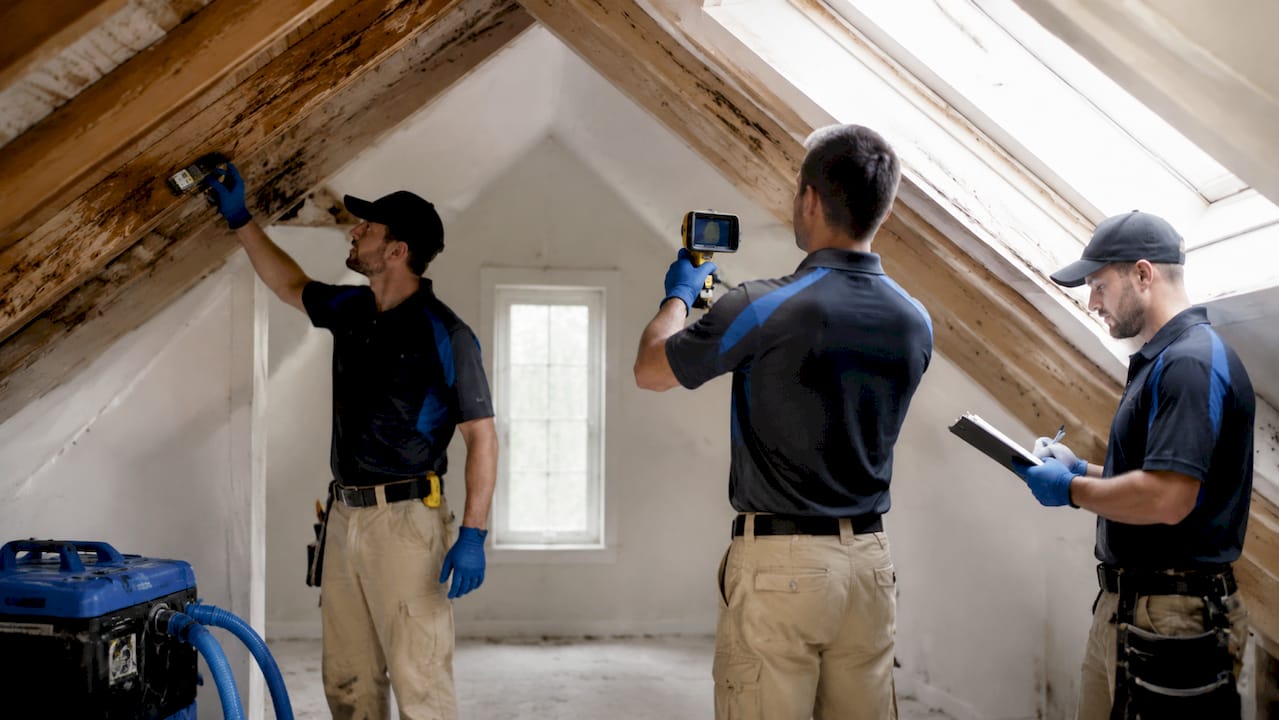
Active moisture is the single biggest predictor of mold regrowth. Inspectors use infrared cameras and calibrated moisture meters to map every wall, floor, and ceiling in the affected zone. Undetected active moisture will cause mold to return regardless of how clean the surfaces appear. This step also confirms that the original water source, whether a plumbing leak, roof intrusion, or basement seepage, has been fully repaired.
Step 3: Air and surface sampling
Air samples are collected inside the remediated area and, critically, outdoors. The outdoor sample establishes a baseline spore count for the local environment on that specific day. Surface samples, typically tape lifts or swabs, target areas where mold was heaviest or where the inspector sees suspicious residue. Testing during active filtration or with debris still present produces false results, so the site must be prepared correctly before sampling begins.
Step 4: Laboratory analysis
Samples go to an accredited laboratory, which returns results within 24–48 hours. The lab identifies:
- Total spore counts per cubic meter of air
- Species present, including water-damage indicator species like Stachybotrys and Chaetomium
- Surface contamination levels compared to control samples
- Any anomalies that suggest incomplete remediation
Step 5: Clearance report
The inspector compiles all findings into a formal clearance report. This document states whether the property passes or fails, lists all spore counts and moisture readings, and provides a professional interpretation. A passing report is a legal document that protects you in real estate transactions and insurance claims.
Why is independent third-party testing critical?
The same company that performed the remediation cannot objectively verify its own work. This is not a matter of trust. It is a structural conflict of interest that insurers and courts recognize and discount.
Only independent third-party assessments are considered the gold standard for completion verification. When a remediation contractor objects to bringing in an outside inspector, that objection is itself a red flag. A contractor confident in their work welcomes independent review.
The legal stakes are real. Clearance reports from independent inspectors serve as certified proof of property health for future buyers, lenders, and insurance adjusters. A report signed by the same company that did the cleanup carries almost no weight in a dispute. Independent certification, by contrast, is defensible in court and accepted by most major insurers.
Qualified independent inspectors hold certifications such as the IICRC’s Applied Microbial Remediation Technician (AMRT) credential or are licensed as Certified Industrial Hygienists (CIH). When you hire an inspector, ask for their certification number and confirm they have no financial relationship with your remediation contractor.
Pro Tip: Ask your inspector to provide a written statement confirming they have no affiliation with the remediation company. This one sentence protects you if a dispute arises later.
What causes mold remediation to fail quality assurance testing?
Clearance failures are more common than most property owners expect. Understanding the causes helps you catch problems before the inspector does.
- Breached containment barriers. If plastic sheeting tears or a zipper door is left open during remediation, mold spores spread to clean areas of the home. HVAC contamination and cross-site contamination during remediation are among the most frequent reasons for clearance failure. Proper containment, including negative air pressure, prevents this.
- Unresolved moisture sources. Remediation without repairing the original water source is incomplete by definition. Industry standards mandate moisture source correction before clearance testing, or the remediation is considered unfinished. Mold will return within days if the leak or condensation problem remains.
- Insufficient HEPA filtration. Remediation stirs up spores. Air scrubbers with HEPA filters must run throughout the active work phase to capture airborne particles. If filtration was inadequate, spores settle on surfaces throughout the containment zone and elevate air sample counts.
- Overlooked areas. Inspectors regularly find mold behind baseboards, inside wall cavities, under flooring, and in HVAC ducts that the remediation team missed. A thorough scope of work before remediation begins reduces this risk significantly.
- Inadequate cleaning of non-porous surfaces. Hard surfaces like concrete, metal, and glass require physical scrubbing with an EPA-registered antimicrobial agent. Wiping without scrubbing leaves viable spores behind.
When a property fails clearance, the remediation contractor must address every identified deficiency and then schedule a retest. You should not pay for the retest if the failure resulted from the contractor’s incomplete work. Get this in writing before remediation begins.
Pro Tip: Request a detailed scope of work from your remediation contractor before work starts. A written scope makes it easier to identify exactly where the process broke down if clearance testing fails.
How do you interpret a mold clearance report?
A clearance report contains several data points, and knowing what each one means prevents confusion and protects you from accepting a flawed result.
| Report Element | What It Means |
|---|---|
| Indoor spore count vs. outdoor baseline | Indoor counts at or below outdoor levels indicate successful remediation. |
| Water-damage indicator species | Stachybotrys or Chaetomium elevated indoors signals incomplete removal. |
| Moisture meter readings | Readings above 16% in wood or 1% in concrete suggest active moisture remains. |
| Visual inspection notes | Any noted debris, residue, or containment breach is grounds for a failed report. |
| Pass/Fail status | The inspector’s professional determination based on all combined data points. |
A clean clearance result means indoor spore counts are at or below outdoor background levels, with no elevated water-damage indicator species present. That benchmark is the core of mold removal quality control, and it is the number you should focus on first when you receive the report.
The professional interpretation section matters as much as the raw numbers. An inspector may note that counts are technically within range but that a specific species is present at levels worth monitoring. Read this section carefully and ask questions if anything is unclear.
Clearance reports also carry significant weight beyond your immediate health concerns. Buyers increasingly request mold inspection documentation before closing on a property. A clean, independently verified report adds credibility to your disclosure and can prevent a sale from falling through. For more on how this documentation affects transactions, remediated mold and buyers is a useful reference.
Best practices for scheduling quality assurance testing
Timing the verification phase correctly is as important as the testing itself. A poorly timed test produces misleading results and wastes money.
- Wait for the full drying period. Active remediation takes 1–5 days, followed by a mandatory 24–72 hour drying period before verification testing can begin. Testing too early, while materials are still damp, will produce elevated moisture readings and potentially elevated spore counts.
- Turn off air movers and dehumidifiers before sampling. Equipment must be off for at least 24 hours before air samples are collected. Running equipment during sampling artificially cleans the air and can produce a false pass result.
- Keep containment sealed until the inspector clears the site. Do not remove plastic sheeting or open containment barriers before the inspector arrives. Breaking containment early allows unfiltered air from the rest of the property to enter and contaminate the test environment.
- Verify inspector credentials before booking. Confirm IICRC AMRT certification or equivalent, and confirm the inspector has no financial relationship with your remediation contractor.
- Budget for retesting. Plan financially for the possibility of one retest. Properties with extensive contamination or complex moisture problems fail clearance more often than straightforward jobs.
Understanding mold remediation success also depends on controlling moisture long after the inspector leaves. Moisture control is the critical foundation for preventing mold recurrence, and remediation without moisture source repair is incomplete. Review your basement mold causes if the original problem originated below grade.
Key Takeaways
Mold remediation quality assurance requires independent third-party verification using visual inspection, moisture mapping, air sampling, and laboratory analysis to produce a legally defensible clearance report.
| Point | Details |
|---|---|
| Independent testing is non-negotiable | The same contractor cannot verify their own work; insurers and courts reject self-issued clearance reports. |
| Moisture must be resolved first | Active leaks or elevated moisture readings will cause mold to return, making clearance impossible. |
| Timing the test correctly matters | Air movers and dehumidifiers must be off for 24 hours before sampling to avoid false results. |
| Clearance reports protect your property value | Independent reports serve as legal documents for real estate transactions and insurance claims. |
| Failed clearance requires contractor correction | Remediation contractors must fix all deficiencies at no additional cost before retesting. |
What I’ve learned from watching homeowners skip this step
I have seen the same scenario play out more times than I can count. A homeowner hires a remediation crew, the work looks clean, and everyone moves on. Six months later, the musty smell returns. The mold is back, often in a new area, because the original moisture source was never confirmed as repaired and no one verified the spore counts after the job.
The part that frustrates me most is that the fix is not complicated. Independent testing costs a fraction of what a second remediation job costs. Yet property owners skip it because the contractor says the job is done and the surfaces look clean. Visual cleanliness is not clearance. It never has been.
What I tell every homeowner I work with is this: the clearance report is not a formality. It is the only objective proof you have that the work was done correctly. Without it, you are taking the contractor’s word on a health and financial matter that could affect your family for years.
Moisture control deserves equal attention. I have reviewed cases where remediation was technically successful, but the property developed new mold growth within a season because a slow plumbing drip was dismissed as minor. Mold does not need much. Fix the source, verify the fix, then test.
— John
Masterservicepro’s approach to certified mold remediation
Masterservicepro follows ANSI/IICRC S520 standards on every remediation project in Lake County, Cook County, DuPage County, Will County, and Kane County, IL. Their IICRC-certified technicians handle the full scope of work, from containment setup through physical removal and drying, and they coordinate with independent inspectors for third-party clearance testing so you receive an unbiased result.
Every project includes transparent reporting and direct guidance on what your clearance report means for your property. If you are dealing with a mold problem connected to water damage, their mold remediation guide for homeowners is a strong starting point. Contact Masterservicepro to schedule an assessment and get the documented proof that your home is safe.
FAQ
What is post-remediation verification?
Post-remediation verification is the independent inspection and testing process that confirms mold removal was successful. It includes visual inspection, moisture assessment, air and surface sampling, and a formal clearance report.
How long does mold remediation quality assurance take?
Active remediation takes 1–5 days, followed by a 24–72 hour drying period before testing begins. Laboratory results return within 24–48 hours, so the full process typically spans one to two weeks.
Can the remediation contractor perform their own clearance testing?
No. Self-issued clearance reports are not accepted as credible by insurers or courts. Only an independent third-party inspector provides a legally defensible clearance result.
What does a passing clearance report look like?
A passing report shows indoor spore counts at or below outdoor baseline levels, no elevated water-damage indicator species, moisture readings within acceptable limits, and a clean visual inspection with no debris or containment breaches.
Why would a property fail mold clearance testing?
The most common causes are breached containment barriers, unresolved moisture sources, insufficient HEPA filtration during remediation, and areas of mold growth that the remediation team missed. Each failure requires corrective work and a full retest before the property can be cleared.