
A water damage restoration estimate is a professional cost projection that forecasts the expense of drying, cleaning, and repairing a property after water intrusion, based on contamination type, absorption severity, and affected square footage. The industry term for this process is a restoration scope of work, and it follows ANSI/IICRC S500 standards to classify damage before any pricing begins. Nationwide costs average around $3,860, ranging from $1,383 to $6,370 for mitigation alone, though major Category 3 losses can exceed $23,800. Understanding what drives these numbers puts you in a much stronger position when reviewing any water damage repair quote.
What is a water damage restoration estimate and how is it built?
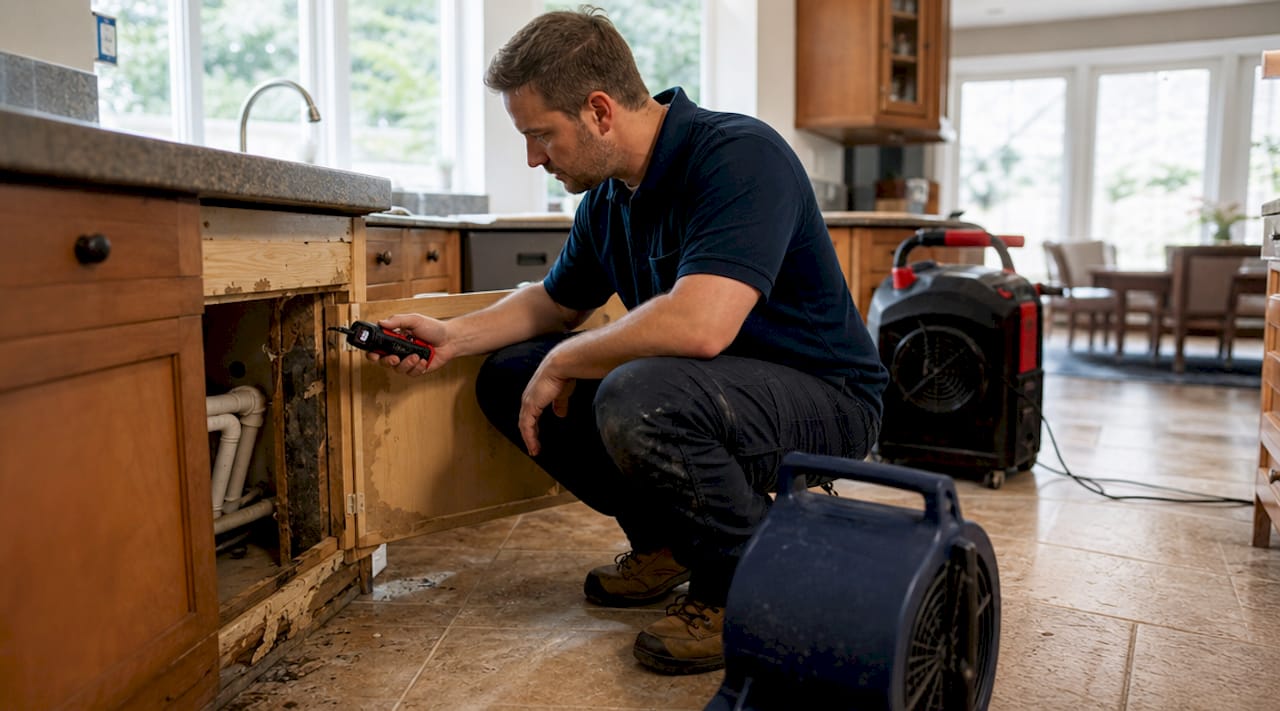
A restoration estimate is not a simple flat-rate quote. It is a line-item document that accounts for water extraction, structural drying, demolition, equipment deployment, monitoring, and in many cases mold remediation. Each of those line items is priced based on the classification of the water source and the extent of absorption into building materials.
The ANSI/IICRC S500 standard is the foundation every credible restoration contractor uses. It defines both the contamination category of the water and the class of damage based on how deeply water has absorbed into porous materials. These two variables determine which equipment is needed, how long drying will take, and what safety measures are required. Without this classification, a quote is essentially a guess.
Insurance involvement adds another layer. Most carriers require a formal written estimate before approving any work, and many use Xactimate software to generate their own parallel assessment. Knowing how your contractor’s estimate was built, and how it compares to the insurer’s version, is where most homeowners lose money.
How water damage categories and classes shape the estimate
The ANSI/IICRC S500 standard divides water damage into three contamination categories and four absorption classes. Both directly control the scope and cost of any restoration estimate.
Categories by contamination level:
- Category 1 (clean water): Originates from a supply line, rain intrusion, or appliance malfunction with no contaminants. Lowest risk, lowest cost.
- Category 2 (gray water): Contains biological or chemical contaminants from sources like washing machine overflow or toilet bowl water. Requires personal protective equipment (PPE) and containment measures.
- Category 3 (black water): Sewage, floodwater, or any water that has sat long enough to become grossly contaminated. Demands aggressive removal, EPA-approved antimicrobials, and full containment.
Classes by absorption depth:
Class 1 affects less than 5% of porous materials in the space. Class 2 affects 5 to 40%. Class 3 affects more than 40% of surfaces, including walls and ceilings. Class 4 involves deeply held water in hardwood floors, concrete, or plaster that requires specialty drying equipment and extended timelines.
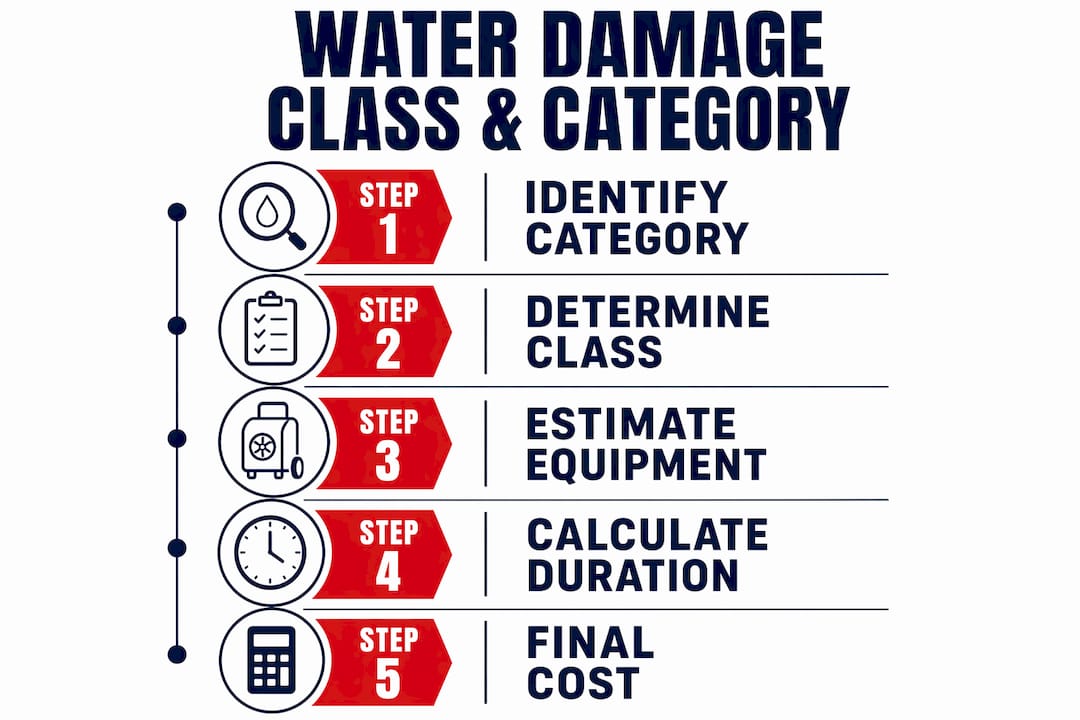
A Class 1, Category 1 loss in a bathroom might involve two air movers, one dehumidifier, and three days of drying. A Class 3, Category 3 loss in a finished basement requires industrial dehumidifiers, negative air machines, antimicrobial treatment, full demolition of drywall to the flood cut line, and potentially five to seven days of monitored drying. The cost difference between those two scenarios is not incremental. It is often tenfold.
Pro Tip: Ask your contractor to state the category and class in writing on the estimate. If those terms are absent, the scope may be under-built, which means you could face additional charges mid-project when the true extent of damage becomes clear.
Misclassifying Category 2 as Category 1 means wrong PPE, no containment, and potential cross-contamination to unaffected areas. That mistake creates both a health risk and a cost dispute with your insurer down the line.
What does a restoration estimate actually cost?
Restoration pricing breaks down by water type and affected area. Per-square-foot costs run $3 to $4 for clean water, $4 to $7 for gray water, and $7 to $15 for black water. Those ranges reflect the added labor, equipment, and safety requirements at each contamination level.
| Damage type | Estimated cost per sq. ft. | Typical total range |
|---|---|---|
| Category 1 (clean water) | $3 – $4 | $1,500 – $5,000 |
| Category 2 (gray water) | $4 – $7 | $3,000 – $10,000 |
| Category 3 (black water) | $7 – $15 | $7,000 – $23,800+ |
These figures cover mitigation only. Reconstruction costs, including drywall replacement, painting, and flooring installation, are separate line items not included in the ranges above.
Common line items you will see on a restoration estimate include:
- Water extraction: Truck-mounted or portable extraction units, priced per hour or per square foot
- Flood cuts: Demolition of drywall to 12 inches above the waterline to allow structural drying
- Drying equipment: Air movers and dehumidifiers, typically priced per unit per day
- Monitoring: Daily psychrometric readings and moisture mapping to document drying progress
- Antimicrobial treatment: Applied to affected surfaces in Category 2 and 3 losses
- Content handling: Moving, cleaning, or storing personal property during restoration
- Mold remediation: Added when moisture has been present long enough for growth to begin
Quotes vary from $2,650 for minor losses to over $23,800 for major Category 3 events with containment and aggressive structural removal. That range reflects how dramatically scope changes based on classification, not just square footage.
Pro Tip: Review every line item description carefully. “Detach and Reset” means a material is removed and reinstalled without replacement. “Remove and Replace” means full replacement. Confusing the two can result in a lower payout that does not actually cover the work required.
How insurance estimates and restoration estimates differ
Insurance adjusters and restoration contractors often produce very different numbers for the same loss. Understanding why protects you from accepting a settlement that falls short of actual repair costs.
- The adjuster uses Xactimate. Insurance adjusters rely on Xactimate software to generate line-item estimates based on regional pricing databases. These estimates are often conservative and may not reflect the full scope a certified contractor identifies on-site.
- Restoration companies scope more thoroughly. An IICRC-certified contractor performs a physical inspection, uses moisture meters and thermal imaging, and builds the estimate from observed conditions. They may identify affected areas the adjuster missed entirely.
- Line item language matters. Insurance estimates use code prefixes like WTR for water extraction, DRY for drywall, and FCW for flooring. Understanding Detach and Reset versus Remove and Replace prevents underpayment on materials that require full replacement.
- RCV versus ACV affects your payout. Replacement Cost Value covers the full repair cost. Actual Cash Value deducts depreciation and reduces the initial check you receive. Knowing which policy you hold changes how you interpret the estimate total.
- Supplements are normal and expected. If the restoration contractor’s scope exceeds the insurer’s estimate, a supplement is submitted with documentation. This is standard practice, not a dispute. Carriers review and approve supplements regularly when they are supported by moisture data and photos.
Get at least two independent restoration estimates before accepting the insurer’s number. If both contractor estimates align and exceed the adjuster’s figure, you have a strong basis for a supplement. Reviewing insurance versus contractor estimates before signing anything is one of the most protective steps you can take.
How to read and verify your restoration estimate
Reading a restoration estimate confidently requires knowing what to look for beyond the total cost. These are the specific elements worth scrutinizing.
- Moisture mapping documentation: A credible estimate references baseline moisture readings and identifies affected zones by room and material. Moisture mapping and daily verification are what separate professional restoration from basic drying services.
- Drying duration and equipment count: The estimate should specify how many air movers and dehumidifiers will be deployed and for how many days. Vague language like “drying as needed” is a red flag.
- Environmental control plan: Humidity control, vapor pressure targets, and adaptive drying strategies should appear in the scope. These are not optional extras. They are the mechanism that proves drying was completed correctly.
- Category and class notation: Both should appear on the written estimate. They act as scope triggers that justify every other line item in the document.
- Response time impact: The longer water sits, the higher the class of damage and the more materials require demolition. Calling a certified contractor within 24 to 48 hours consistently reduces total restoration costs and limits mold risk.
Understanding how long drying actually takes helps you evaluate whether the drying duration on your estimate is realistic or artificially shortened to lower the quote. Ask your contractor to walk you through the drying timeline line by line.
Key takeaways
A water damage restoration estimate is only as reliable as the classification system behind it. Estimates built on ANSI/IICRC S500 categories and classes, supported by moisture mapping and daily drying data, withstand carrier reviews and protect homeowners from incomplete repairs.
| Point | Details |
|---|---|
| Classification drives cost | ANSI/IICRC S500 category and class determine equipment, safety measures, and total estimate scope. |
| Cost ranges vary widely | Clean water runs $3 to $4 per sq. ft.; black water reaches $7 to $15 per sq. ft. before reconstruction. |
| Insurance estimates often fall short | Adjusters use Xactimate, which may miss scope items a certified contractor identifies on-site. |
| Documentation protects you | Moisture mapping and daily psychrometric data make estimates defensible against carrier challenges. |
| Speed reduces total cost | Responding within 24 to 48 hours limits absorption depth, class escalation, and mold risk. |
What I’ve learned from reading hundreds of restoration estimates
After reviewing restoration scopes across Lake County, Cook County, and DuPage County, the pattern I see most often is not fraud. It is under-scoping driven by misclassification. A contractor walks in, sees standing water from a washing machine overflow, calls it Category 1 because it looks clean, and writes a quote that skips containment and antimicrobial treatment entirely. Three weeks later, the homeowner has a mold problem that was entirely preventable.
The second most common issue is homeowners accepting the insurer’s Xactimate estimate without comparison. Xactimate is a legitimate tool, but it prices from regional averages, not from the actual conditions in your home. I have seen estimates that listed “Detach and Reset” for flooring that was clearly saturated and warped beyond reuse. That single line item difference can represent thousands of dollars.
My honest advice: treat the total cost as the last number you look at, not the first. Read the category, the class, the equipment list, and the drying duration. If those four elements are specific and defensible, the total will be accurate. If they are vague, the total is unreliable regardless of whether it looks reasonable. And if you are ever unsure, ask for a second opinion before signing anything. A certified contractor will not be offended by that request. An under-qualified one will.
— John
Get professional help with your restoration estimate
If you are looking at a water damage repair quote and are not sure whether the drying timeline is realistic, Masterservicepro can help. Our IICRC-certified technicians serve Lake County, Cook County, DuPage County, Will County, and Kane County, IL, and we build every estimate on documented moisture data and ANSI/IICRC S500 classifications. Understanding how long drying takes is the first step toward knowing whether your quote reflects the full scope of work. If mold is already a concern, our mold remediation guide walks you through what comes next. Contact Masterservicepro today to schedule an assessment or review your current estimate with a certified technician.
FAQ
What does a water damage restoration estimate include?
A water damage restoration estimate includes line items for water extraction, structural drying equipment, demolition, antimicrobial treatment, monitoring, and content handling. Reconstruction costs like drywall replacement and flooring are typically listed separately.
What is the average cost of water damage restoration?
The national average cost of water damage restoration is approximately $3,860, with a typical range of $1,383 to $6,370 for mitigation only. Major Category 3 losses with contamination and aggressive removal can exceed $23,800.
How do categories and classes affect restoration pricing?
ANSI/IICRC S500 categories define contamination level and classes define absorption depth. Higher categories and classes require more equipment, longer drying times, and stricter safety protocols, all of which increase the total estimate.
Why does my insurance estimate differ from the contractor’s quote?
Insurance adjusters use Xactimate software based on regional pricing averages, which often produces a lower scope than what a certified contractor identifies through physical inspection and moisture mapping. Supplements can be submitted with documentation to close the gap.
How can I verify that a restoration estimate is accurate?
Look for category and class notation, a specific equipment list with daily rates, moisture mapping references, and a defined drying duration. Estimates supported by daily psychrometric data are more defensible and more likely to reflect the true scope of work.