
Mold inspection frequency for commercial property is defined as the scheduled cadence at which a certified professional assesses a building for mold growth, moisture intrusion, and air quality risks. The industry standard baseline is at least one formal inspection per year, with additional assessments triggered by water intrusion events, elevated humidity, or prior contamination history. For property managers in Lake County, Cook County, DuPage County, and surrounding Illinois areas, getting this schedule right protects tenants, preserves asset value, and keeps you defensible under EPA guidance and local regulations. This article gives you a practical, compliance-focused framework for 2026.
What does federal and state guidance say about mold inspection frequency?
No single enforceable federal law sets a specific mold inspection schedule for commercial buildings. The EPA’s guidance on mold in schools and commercial buildings offers recommendations, not mandates. This distinction matters because it shifts the compliance burden to property managers, who must interpret guidance from multiple agencies and apply it to their specific building type and jurisdiction.
OSHA, the EPA, and the Centers for Disease Control and Prevention all focus primarily on moisture control rather than fixed mold sampling schedules. None of these agencies publish a rule that says “inspect every 12 months.” Instead, they frame mold management as a response to conditions. The EPA remediation framework begins with assessment and moisture correction before any removal work starts, which means inspections are inherently event-driven in federal guidance.
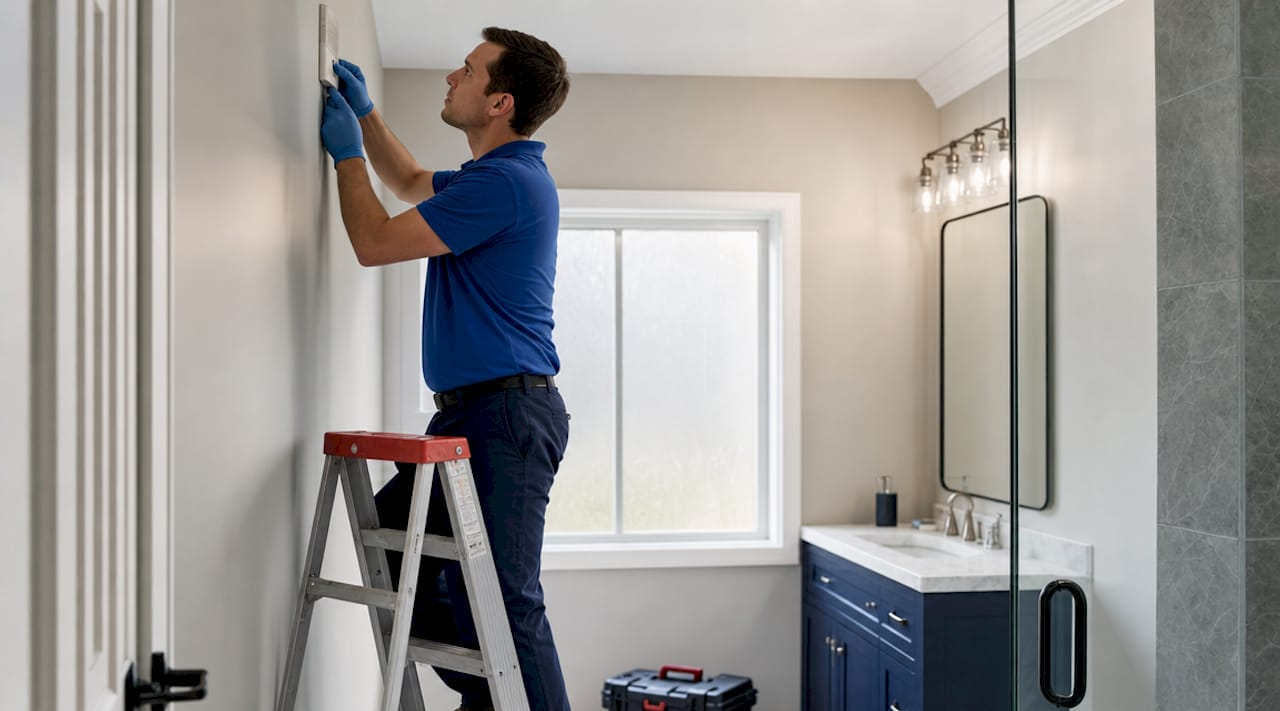
State and local regulations fill some of the gap, but coverage is uneven. Illinois, for example, does not have a standalone commercial mold inspection statute, but OSHA’s General Duty Clause requires employers to maintain workplaces free from recognized hazards, which includes documented mold growth. Healthcare facilities, schools, and public buildings often face stricter local requirements than standard office or retail properties.
Here is what the regulatory landscape means in practical terms for your commercial mold testing schedule:
- No universal federal frequency standard exists. You are responsible for setting a defensible schedule based on your building’s risk profile.
- EPA guidance is the primary reference point for schools and commercial buildings, even though it carries no enforcement teeth on its own.
- OSHA’s General Duty Clause applies if mold creates a recognized health hazard for employees.
- State and local rules vary. Check with your county health department and building code office for jurisdiction-specific requirements.
- Healthcare, schools, and public housing face tighter scrutiny. HUD’s NSPIRE inspection protocol, for instance, flags mold-like substances based on visual evidence and moisture-prone zones, not lab confirmation alone.
The absence of a hard federal standard is not a green light to skip inspections. It means your documentation and scheduling decisions carry more weight, not less.
How risk factors and events should drive your inspection schedule
Annual inspections are the recommended baseline for most commercial properties, with quarterly assessments advised for high-risk buildings. High-risk conditions include elevated indoor humidity, older HVAC systems, a history of water intrusion within the past 12 months, or buildings with known prior mold contamination. Annual is a floor, not a ceiling.
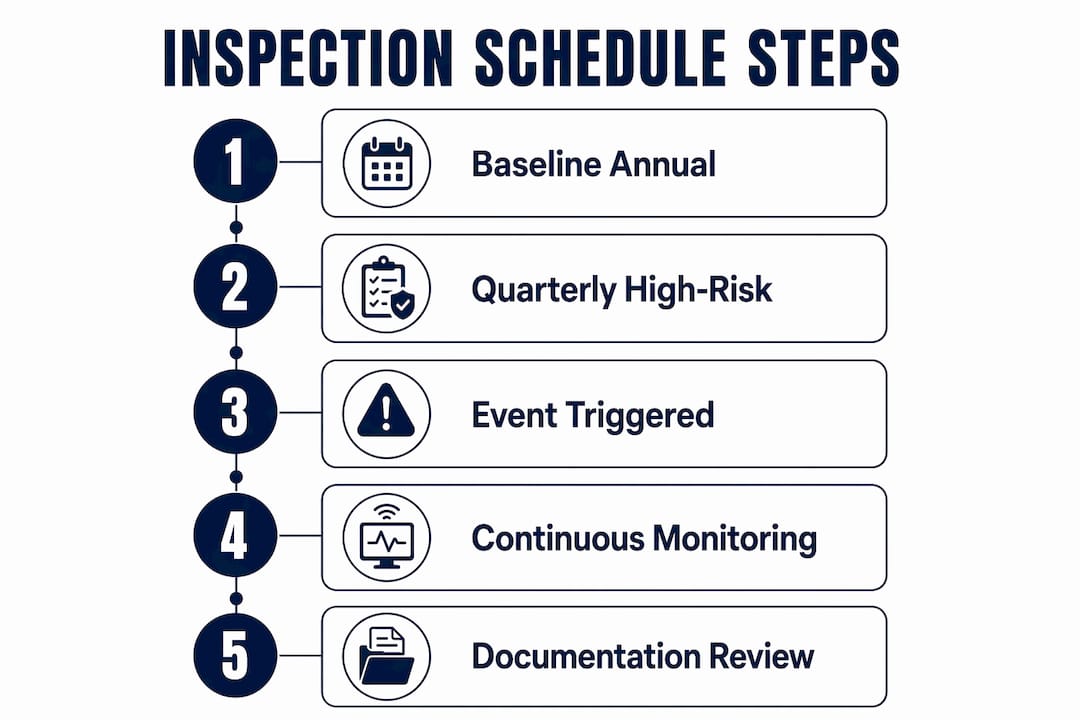
The most urgent trigger for an unscheduled inspection is water intrusion. Mold begins growing within 24 to 48 hours after sustained moisture exposure. A burst pipe, roof leak, or flooded basement is not a “wait and see” situation. Scheduling a mold assessment for your business within that window gives you the best chance of containing growth before it spreads to structural materials or HVAC ductwork.
Here is a numbered framework for setting your commercial mold evaluation frequency based on risk:
- Low-risk buildings (newer construction, no moisture history, controlled humidity): Annual inspection minimum.
- Moderate-risk buildings (older HVAC, occasional humidity spikes, minor past leaks): Semi-annual inspections plus a post-event assessment after any water intrusion.
- High-risk buildings (prior mold remediation, chronic humidity, flat roofs, basement mechanical rooms): Quarterly inspections with continuous moisture monitoring in vulnerable zones.
- Post-event inspections: Schedule within 24 to 48 hours of any flooding, plumbing failure, or roof breach, regardless of your regular calendar.
- Post-remediation verification: Always conduct a clearance inspection after any remediation work to confirm the problem is resolved before closing out the project.
Pro Tip: Install low-cost humidity sensors in mechanical rooms, restrooms, and basement areas. Continuous moisture data tells you when conditions are trending toward mold-favorable territory, so you can schedule an inspection before visible growth appears rather than after.
Moisture source identification must accompany every inspection. An inspection that finds mold without identifying the moisture source is incomplete. The EPA’s sequential remediation workflow makes moisture correction a prerequisite for effective mold removal, and the same logic applies to inspections.
What happens during a commercial mold inspection?
Understanding the inspection process helps you plan your schedule and budget accurately. A commercial mold inspection is formally called a mold assessment, and it differs from a residential inspection in scope, complexity, and cost.
| Phase | Typical Duration | Key Activity |
|---|---|---|
| On-site visual assessment | 1 to 2 hours (targeted) or full day (large buildings) | Inspector examines moisture-prone areas, HVAC systems, and visible surfaces |
| Air and surface sampling | Included in on-site time | Spore trap or swab samples collected for lab analysis |
| Lab processing | 3 to 5 business days | Samples analyzed for mold species and concentration |
| Report delivery | 1 to 2 days after lab results | Written findings, moisture readings, and remediation recommendations |
On-site inspection time ranges from one to two hours for targeted assessments up to a full day for large or complex buildings. Lab results typically arrive within three to five business days. Factor this timeline into your planning. If you are responding to a water intrusion event, you need results fast, so discuss rush processing options with your inspector upfront.
Commercial inspections cost more than residential ones due to building size and HVAC complexity. Commercial mold inspection costs range from $600 to $2,500 or more in 2026, depending on square footage, the number of samples collected, and whether HVAC evaluation is included. For business owners, these costs are generally tax-deductible as a property maintenance expense, though you should confirm this with your accountant.
Key deliverables you should expect from every commercial mold assessment:
- A written report documenting all findings, moisture readings, and sample locations
- Lab results identifying mold species and spore concentrations
- A clear distinction between assessment findings and remediation recommendations
- Photographic documentation of problem areas
- A moisture map identifying the source and extent of water intrusion
Calendar-based vs. event-triggered vs. risk-based scheduling
Most property managers default to calendar-based scheduling because it is simple to administer. You set a date, book the inspector, and check the box. The limitation is that a fixed annual date may fall months after a moisture event has already allowed mold to establish itself.
| Approach | Best For | Limitation |
|---|---|---|
| Calendar-based (annual or semi-annual) | Low-risk buildings with stable conditions | Misses mold growth triggered between scheduled dates |
| Event-triggered | All buildings after water intrusion, leaks, or remodeling | Reactive only; does not catch slow-developing moisture problems |
| Risk-based with moisture monitoring | High-risk or complex buildings | Requires upfront investment in sensors and tracking systems |
Event-triggered scheduling is non-negotiable after any water intrusion. Moisture control and rapid response are the most critical factors in mold prevention, and a delayed inspection after a flood or leak is one of the most common reasons mold problems escalate into expensive remediation projects.
Risk-based scheduling is the most defensible approach for complex commercial properties. Moisture monitoring in mechanical rooms, restrooms, and basements gives you real-time data to decide when an inspection is genuinely necessary. This approach reduces unnecessary inspections in stable periods while catching problems early in vulnerable zones.
Pro Tip: Combine all three approaches. Use calendar-based scheduling as your baseline, layer in event-triggered inspections after any moisture event, and use moisture sensor data to adjust frequency in high-risk areas. This gives you both predictability and responsiveness.
Practical guidelines for managing your mold inspection program
A mold inspection program is only as effective as the records and processes behind it. Clearly separating mold assessment from remediation and maintaining detailed documentation improves compliance, supports insurance claims, and prevents recurrence. Here is how to build a program that holds up under scrutiny:
- Sync inspections with seasonal patterns. In Illinois, late spring and late summer bring peak humidity. Schedule at least one annual inspection to coincide with high-humidity months, when mold risk is greatest.
- Maintain a moisture event log. Record every plumbing leak, roof breach, or flooding incident with dates, affected areas, and response actions. This log is your primary defense in an insurance claim or tenant dispute.
- Keep all inspection reports on file for at least five years. Inspectors, insurers, and regulators may request historical records, especially if a contamination issue surfaces later.
- Coordinate remediation and re-inspection. When an inspection identifies contamination, work with a certified remediation contractor and schedule a clearance inspection after the work is complete. Do not skip the clearance step.
- Budget $600 to $2,500 per inspection cycle for most commercial properties, with larger or more complex buildings at the higher end. Multi-building portfolios benefit from negotiated annual service agreements with a single certified provider.
- Verify your inspector’s credentials. Look for IICRC certification or credentials from the American Industrial Hygiene Association (AIHA). Certified inspectors produce reports that carry more weight with insurers and regulators.
For mold inspection in commercial office spaces and schools, the documentation standard is especially high because occupant health and regulatory scrutiny are both elevated. Treat every inspection report as a legal document, not just a maintenance record.
Key takeaways
Effective commercial property mold management requires at minimum an annual inspection, with frequency increasing based on water intrusion history, humidity levels, and building age.
| Point | Details |
|---|---|
| Annual inspection is the baseline | Most commercial properties need at least one certified mold assessment per year as a minimum standard. |
| Water intrusion triggers immediate action | Schedule an inspection within 24 to 48 hours of any flooding or plumbing failure to prevent mold establishment. |
| High-risk buildings need quarterly checks | Buildings with older HVAC, prior mold history, or chronic humidity require inspections every three months. |
| Documentation is your legal protection | Maintain inspection reports, moisture logs, and remediation records for at least five years. |
| Moisture control outweighs inspection frequency | Fixing moisture sources is more effective than increasing inspection frequency without addressing root causes. |
Why I think most commercial mold programs get the scheduling backwards
After years of working with property managers across Lake County and Cook County, the pattern I see most often is this: buildings get inspected on a fixed annual calendar, a moisture event happens in month four, and by month twelve the mold problem is extensive and expensive. The inspection schedule looked responsible on paper, but it was disconnected from what was actually happening in the building.
The properties that handle mold well are not the ones with the most frequent inspections. They are the ones with the best moisture tracking. When you know your basement mechanical room hit 75% relative humidity for three consecutive weeks in July, you do not wait until December for your scheduled inspection. You call for an assessment now.
I also see too many managers treat a mold inspection as a standalone lab test. Treating inspections as isolated lab events without addressing moisture sources produces recurring problems and wasted money. The inspection is the beginning of a process, not the end of one. If your inspector hands you a report and walks away without identifying a moisture source, you have an incomplete assessment.
Build your program around moisture history, not just calendar dates. Document everything. And when contamination is found, move fast. Mold does not wait for your next scheduled inspection date.
— John
How Masterservicepro supports your commercial mold inspection program
Masterservicepro serves commercial property managers across Lake County, Cook County, DuPage County, Will County, and Kane County, IL with IICRC-certified mold inspection, testing, and full remediation services. When water damage or mold is detected, our team responds fast, handles both the inspection and the remediation under one roof, and delivers the documentation you need for insurance and compliance.
If you have recently experienced a flooding event or plumbing failure, understanding how long water damage takes to dry is the first step toward knowing when mold risk becomes real. For properties that need remediation after an inspection, our mold remediation guide walks you through the full process. Contact Masterservicepro to schedule a commercial mold assessment or discuss an ongoing inspection program for your property portfolio.
FAQ
How often should a commercial property be inspected for mold?
Annual inspections are the standard minimum for most commercial properties. Buildings with high humidity, older HVAC systems, or a history of water intrusion should be inspected quarterly.
Does federal law require mold inspections for commercial buildings?
No enforceable federal law mandates a specific mold inspection schedule for commercial properties. EPA and OSHA provide guidance focused on moisture control, but frequency requirements vary by state, locality, and building type.
How quickly should I schedule an inspection after a water leak?
Schedule a mold assessment within 24 to 48 hours of any water intrusion event. Mold can begin growing within that same window, so rapid response is critical to limiting contamination.
What does a commercial mold inspection cost in 2026?
Commercial mold inspections range from $600 to $2,500 or more depending on building size, number of samples, and HVAC evaluation scope. Lab results typically take three to five business days to process.
What is the difference between a mold inspection and a mold assessment?
A mold assessment is the formal industry term for what is commonly called a mold inspection. It includes visual examination, moisture measurement, air and surface sampling, and a written report with remediation recommendations.